


Introduction
Understanding academic inbreeding allows us to review and identify existing patterns of nepotistic practices within academic institutions. Academic inbreeding occurs when institutions, to a larger extent, hire their own graduates or individuals with close connections, potentially undermining meritocracy and favoring nepotism over genuine skills and qualifications. This practice contradicts the principles of the Open Science movement, which advocates for transparency, integrity, and collaboration to enhance the replicability and robustness of scientific research. The lack of transparency in recruitment not only compromises the integrity of the academic recruitment process but possibly also the integrity of the recruiting researchers themselves. It is not a stretch to say that purposefully trying to rig the system to favor less qualified candidates over more qualified ones could be considered fraudulent behavior.
Key Strategies
Three potential strategies used by universities to promote nepotism has been identified:
- Application Period: Some university websites advertise positions with exceptionally short application periods, ranging from only 1 to 9 days, despite policies specifying minimum durations such as 10 days (1), 2 weeks (2,3), 3 weeks (4), or 4 weeks (5). Such short application periods may serve as a strategy to limit applications from external candidates. Additionally, it is common for universities to disclose only the application deadline while omitting the publication date. This practice could conceal short application periods, further reducing the transparency of the hiring process.
- Hidden Ads: This practice involves posting job ads only on the physical bulletin board, making them inaccessible to a wider audience who might otherwise rely on the official webpage for job listings. Such practices can lead to intentional selection bias, limiting the pool of applicants and potentially favoring friends or close colleagues.
- Ignoring Skills and Merits: While the two above mentioned practices aims to limit the total number of applicants, and thereby reducing the risk that an external candidate applies with better skills and merits than your internal candidate (friends or close colleague), this last practice is employed once a better external candidate has applied. Although the details are quite unclear how the recruiter reasons, it has been documented where current students (internal candidates) are given the position over applicants (external candidates) with multiple master’s’ degrees, work experience, and academic merits.
While three strategies have been identified, only two are feasible to investigate given the current resources and tools available. The strategies involving Application Period and Hidden Ads can be effectively explored through automated scripts that collect job advertisement data from university websites. These scripts can analyze the duration of application periods and the availability of job postings. The strategy of Ignoring Skills and Merits, while theoretically possible to investigate, presents significant logistical challenges. This would require accessing all submitted documents for each recruitment decision to compare the qualifications of candidates. Such an investigation would involve a considerable investment of time and resources to determine if the selected candidates were indeed the most qualified. Thus, that practice remains outside the scope of the current experiment but is noted as an area for potential future research.
Research questions that arise from this investigation include:
- What is the usual length of application periods, and what patterns emerge in their distribution?
- What proportion of job ads do not adhere to their institution’s prescribed hiring policies regarding application periods?
- What proportion of job advertisements are restricted to physical bulletin boards and not posted on official websites?
- In what ways do these hiring practices differ by university, job category, and time period?
Method
Design
Mixed-Method Explanatory Sequential Design
Method
To investigate these potential nepotism promoting strategies, I developed custom web-scraping scripts in R to collect academic job advertisement data from Swedish universities. The dataset includes over of 100’000 unique job ads collected over since 2011. Quantitative data were followed-up using semi-structured interviews with the head of recruitment and/or president of the university.
Note: Details regarding the data collection process and validation methods are being kept confidential at this time, as data collection is ongoing and publication in a peer-reviewed journal is being considered. However, it can be mentioned that it includes web-scraping of both static and dynamic webpages; using rate-limiting to avoid automatic IP-blocking; and error handling to log, categories, and follow-up records if needed.
Code demo, webscraping job ads from outside academia.
Preliminary Results
Note: Due to ongoing data collection and potential publication in a peer-reviewed journal, most results are being kept confidential at this time. However, preliminary findings indicate several interesting trends and patterns that will be further analyzed and discussed in future updates.
Application Period
Some universities consistently advertised job positions with application periods shorter than their stated policies. Interestingly, despite clear violation of policy documents, the head of the Competence Provision Unit at one of the universities stated that this practice was acceptable (Email communication, 2022-11-21 & 2022-11-23).


Hidden Ads
Many universities regularly published job advertisements that were not available on the official website. One such university had 9.2% of total job ads omitted 2022-11-17, and 4.8% omitted 2023-03-10. This was also corroborated by the head of the Competence Provision Unit at one of the universities, who stated that this was also an acceptable practice (Email communication, 2022-11-21 & 2022-11-23).
Extra
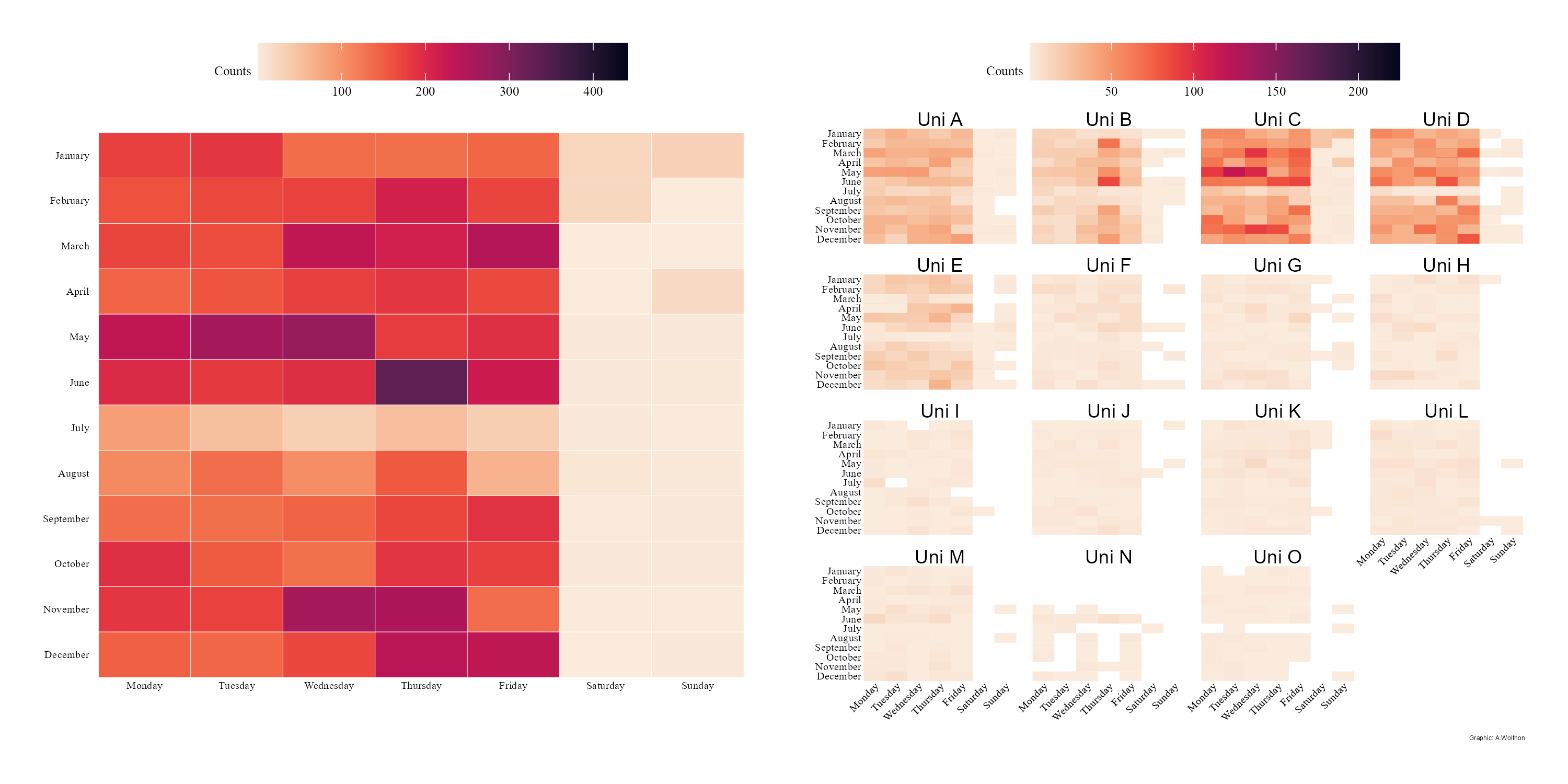
Which are the most common publishing days and months?


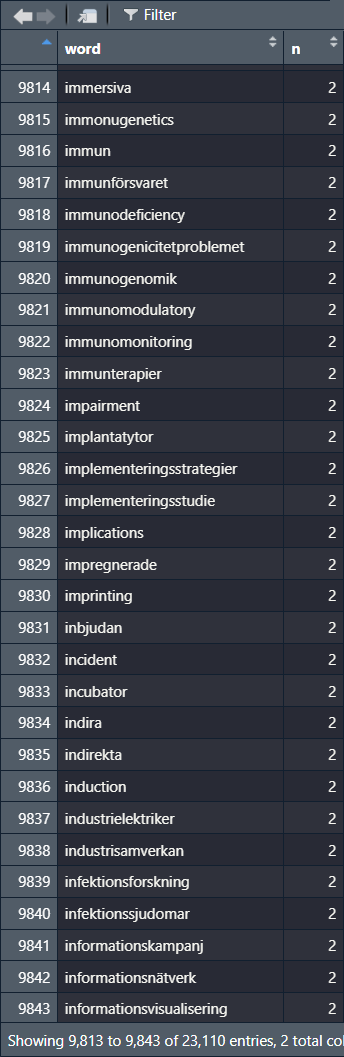
Which are the most common title words?
To better understand the text data, we employ Natural Language Processing (NLP) techniques that begin with a series of preprocessing steps. First, we perform tokenization to split the text into distinct phrases or words. We then apply lowercase conversion to normalize the text. Next, we remove stop words, which are common words that do not add any real meaning to the analysis. Finally, we use lemmatization to reduce words to their root form, guided by a dictionary, which helps retain semantic meaning in contrast to stemming.
Common and uncommon title words (lemmatization not performed)

- Royal Institute of Technology. (2023-03-10). Riktlinje om annonsering av anställning. https://web.archive.org/web/20220308050348/https://intra.kth.se/polopoly_fs/1.662028.1593060751!/Riktlinje-om-annonsering-av-anst%C3%A4llning.pdf
- Uppsala University. (2023-03-10). Publicering av annons. https://web.archive.org/web/20230310193820/https://mp.uu.se/sv/web/info/stod/kompetens-rekrytering/rekryteringsprocessen/annonsering/publicering-av-annons
- Karolinska Institute. (2023-03-10). Informera och annonsera. https://web.archive.org/web/20230310194110/https://medarbetare.ki.se/2-informera-och-annonsera
- Umeå University. (2023-03-10). Rekryteringsprocessen 2: Rekrytera. https://web.archive.org/web/20230310194318/http://web.archive.org/screenshot/https://www.aurora.umu.se/stod-och-service/administration-och-chef/hr-guiden/kompetensforsorjning/rekryteringsprocessen/rekryteringsprocessen-rekrytera/
- Lund University. (2023-03-10). Rekrytera – annonsering, urval och välja den bästa. https://web.archive.org/web/20230310194525/https://www.hr-webben.lu.se/rekrytering-vid-lunds-universitet/rekrytera-genom-lararforslagsnamnd/2-rekrytera-annonsering-urval-och-valja-den-basta